« July 2009 | Main | September 2009 »
August 31, 2009
Murdoch guns for public broadcasting
A couple of decades ago in 1989 Rupert Murdoch delivered his MacTaggart lecture, where he argued that television is an area of economic activity, a business, and that competition is invariably preferable to monopoly. Murdoch didn't argue for the death of public service television –-- or the closure of the BBC --- just a reduction in its importance as "part of the market mix, but in no way (dominating) the output".
A commercially-driven system, which he envisaged, largely arrived during the 1990s in the UK – 90% of the UK public now have multichannel digital television, and around half of homes choose to pay for content. BSkyB is currently the most profitable business model for UK television around.
James Murdoch returned to the battle in a powerfully delivered MacTaggart lecture at the 2009 Edinburgh International Television Festival. He launched a scathing attack on the BBC, describing the corporation's size and ambitions as "chilling" and accusing it of mounting a "land grab" in a beleaguered media market. The BBC's news operation was "throttling" the market, preventing its competitors from launching or expanding their own services, particularly online:
Dumping free, state-sponsored news on the market makes it incredibly difficult for journalism to flourish on the internet. Yet it is essential for the future of independent journalism that a fair price can be charged for news to people who value it.
If News Corp is to successfully introduce charges for all its websites (ie., the customer pays a fair price for quality journalism) then it needs to throttle public broadcasting's state sponsored free provision of news.
James Murdoch's argument appeals to independence and plurality and invokes the spectre of Orwell's 1984. Profit and the free market guarantees independence and plurality and a better society. Like his father he wants a much smaller public broadcaster and light regulation---Murdoch also heavily criticised the UK media industry regulator, Ofcom, calling for regulation to be scaled down.
Is this the American model? Does the appeal to plurality and independence mean Fox News Australia?
The Murdoch argument in Australia would be that the ABC's news operation was "throttling" the market, preventing its competitors from launching or expanding their own services, particularly online. Is the ABC too big, potentially a threat to paid-for journalism and inhibiting the ability of commercial competitors to invest in news?
Posted by Gary Sauer-Thompson at 9:29 AM | Comments (24) | TrackBack
UN judgment on NT intervention
James Anaya, the Special Rapporteur on the situation of human rights and fundamental freedoms of indigenous people, visited Australia between 17 to 28 August. A rapporteur is a person appointed by a deliberative body to investigate an issue or a situation, and report back to that body. Aboriginal groups, church leaders and social justice groups have invited the United Nations to investigate whether the intervention in the Northern Territory is a violation of human rights.
Anaya's judgement was forthright. He points his finger on indigenous people having endured tremendous suffering at the hands of historical forces and entrenched racism and the way that these historical forces continue to make their presence known today, manifesting themselves in serious disparities between indigenous and non-indigenous parts of society, including in terms of life expectancy, basic health, education, unemployment, incarceration, children placed under care and protection orders, and access to basic services.
He acknowledged that the Government has developed and implemented a number of important initiatives in order to “close the gap” of indigenous disadvantage within a wide range of social and economic areas, with a stated emphasis on women and children.
Anaya added:
After several days in Australia listening and learning... I have observed a need to develop new initiatives and reform existing ones in consultation and real partnership with Indigenous peoples to conform with international standards requiring genuine respect for cultural integrity and self determination...Of particular concern is the Northern Territory Emergency Response. These measures overtly discriminate against Aboriginal peoples, infringe their right of self-determination and stigmatise already stigmatised communities
He says that affirmative measures by the Government to address the extreme disadvantage faced by indigenous peoples and issues of safety for children and women are not only justified, but they are in fact required under Australia’s international human rights obligations. He adds:
However, any such measure must be devised and carried out with due regard of the rights of indigenous peoples to self-determination and to be free from racial discrimination and indignity. In this connection, any special measure that infringes on the basic rights of indigenous peoples must be narrowly tailored, proportional, and necessary to achieve the legitimate objectives being pursued.
Is this the case in Australia?
In my view, the Northern Territory Emergency Response is not. In my view, the Northern Territory Emergency Response is not. In my opinion, as currently configured and carried out, the Emergency Response is incompatible with Australia’s obligations under the Convention on the Elimination of All Forms of Racial Discrimination and the International Covenant on Civil and Political Rights, treaties to which Australia is a party, as well as incompatible with the Declaration on the Rights of Indigenous Peoples, to which Australia has affirmed its support.
He adds that the objectives of the closing the gap campaign, the Emergency Response, and other current initiatives and proposed efforts of the Government will be best achieved in partnership with indigenous peoples’ own institutions and decision-making bodies, which are those that are most familiar with the local situations. Such initiatives need to affirmatively guarantee the right of indigenous peoples to participate fully at all levels of decision-making in matters which may affect their rights, lives and destinies, as well as to maintain and develop their own decision-making institutions and programmes.
Well we knew that. So did the Howard Government. They use the utilitarian calculus to argue that the intervention would improve the lives of indigenous people--the benefits would outweight the costs. Has the grog stopped? The child abuse? The pornography? How successfully is the compulsory income management? How many houses hav ebeen built by the emergency housing program?
Posted by Gary Sauer-Thompson at 7:45 AM | Comments (7) | TrackBack
August 30, 2009
Canberra gaze: Kev + Julia
Is there a sense of disappointment with the Rudd Government emerging in the body politic? Say a growing realization that the white hot promises about major reform across a number of policy areas are not going to be delivered, and we are left with a kind of muddling along accompanied by a lot of spin and management of the 24 hour news cycle.
Is there a growing understanding that we should be thankful that what we have gained with the ascension of Kev +Julia is that the worst excesses of the Howard regime have gone.
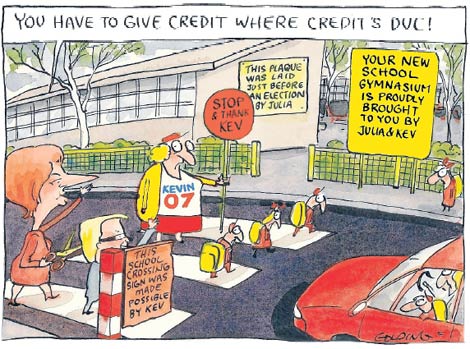
'Change the government change the country' was always heady political rhetoric. The reality is more the traditional muddling through (managing) the global storms whilst protecting the old industries from change; a continuation of Howard on climate change. Where then is the progressive face of the Rudd Government? Where it is pushing reform beyond managing change?
Is one candidate Government 2.0? Some would argue so.
This has grown out of Web 2.0 in an attempt to define a new approach to governing which provides governments and their citizens more direct and immediate ways to communicate, engage and collaborate enabled by Web 2.0 principles and tools. We have the formation of Government 2.0 Taskforce, an issues paper and Senator Kate Lundy’s second and third Public Sphere events that have begun the digital engagement with citizens in Australia.
I have to admit that I was pretty enthused by Lundy's Public Sphere #3 on the Australian ICT & Creative Industries Development. The live feed worked for me in Adelaide despite the contributions from the Brisbane and Melbourne nodals being tech fuzzy; the love blogging was quality work; twitter worked sweetly; and there was digital engagment amongst citizens. So I could participate in a conference that related to my photography and blogging without have to travel by plane and cab to another city---the old 4am start and 10pm finish.
Lundy and co have shown that it can be done. Will the other agencies follow down this path? Or will they--eg., the Department of Health and Ageing--resist? Secondly, though it would make a lot of sense to have some State-specific focus in SA on the issues being examined by the Task Force, I cannot see it happening in SA.
Posted by Gary Sauer-Thompson at 10:34 AM | Comments (9) | TrackBack
August 29, 2009
bringing the banks into line
In an interview in Prospect Magazine Adair Turner, the chair of the Financial Services Authority in the UK, called for the introduction of a new tax to help cap 'excessive' bonuses in the finance sector, a Tobin tax on the trade of currency across borders, as well as describing the finance sector as having “grown beyond a reasonable size.” Bingo.
That speaking truth to power caused ripples, especially in the financial world. In the UK, the policy consensus amongst the City, government and academia is that maintaining the competitiveness of the City of London should be a primary aim for the British economy. Turner's proposal is seen as questioning that consensus --hence the backlash---Turner has lost his marbles.
A question can be asked: is society simply paying too much to the financial system in order for it to allocate money across the economy for us? It's not a question that the financial sector would admit to being a legitimate policy question.
Questioning the bank's financial power is quickly dismissed. The blocks go something like this. If you raise the question of market abuse the response is what is that? The market is self-regulating Pointing to the need for tough regulation to protect retail customers brings forth the "competition ensures that" response.The blocks gives the impression that the financial sector understands its self to be the very embodiment of the great and the good and so there is no need to cut the financial sector down to size because the sector is full of "socially useless activity".
The block seeks to deny that there has been a very fundamental shock to the 'efficient market hypothesis' which has been in the DNA of the FSA and securities and banking regulators throughout the world"
Posted by Gary Sauer-Thompson at 1:40 PM | Comments (1) | TrackBack
August 28, 2009
ICT: infant industry or bootstrap
The third Public sphere: Government 2.0 event is on Australian ICT and Creative Industries Development. It is taking place at the Wollongong Innovation Campus today with nodal points in Melbourne (Trinity College) and Brisbane University of Queensland).
Government 2.0 is a rising topic of debate across the world, due to trends in technology, media and public opinion having made it both more possible and more necessary for governments to reconsider what and how information is made freely available to the public. An earlier public event Public Sphere 2: Government 2.0 was concerned with creating an more participatory form of government in Australia. It was premised on citizens having a right to the information they need to inform themselves about public and political affairs, and to participate in the democratic processes in an informed way.
The aim of this third event is for the government to engage with the ICT and creative industries, as well as the broader community to identify areas where government policy can be developed or enhanced to better facilitate the growth and development of these industries in Australia. The event can be watched live at live wall.
The background to the event is the Lifeguard discussion paper from the Silicon Beach group. The goal is to encourage discussion around the subjects of technology innovation and investment - to foster the growth of Australian technology companies. Hence the network of ICT entrepreneurs, which sadly, does not include Adelaide -----it's Melbourne, Brisbane, Sydney. The high tech Defence state does not have much time for Australian ICT entrepreneurs? They are not interested in building a world-class technology industry in Australia?
The Lifeguard paper says that building:
a world-class technology industry is not easily achieved. Governments around the world have spent billions of dollars in attempts to replicate the success of Silicon Valley, the world's most famous and effective technology centre....The secret of Silicon Valley cannot be replicated with money. It was developed and cultivated over decades.
That implies a generation of work to make the goal, especially when the explicit goal is for Australia to be recognized as an undisputed global centre for technology innovation.
So how do you finance a thriving innovation industry, given the shortage of venture capital? The Rudd Govt's investment in infrastructure is the National Broadband Network. However, its industry policy is about green wash cars, not entrepreneurial ICT and creative industries. The car industry policy was about big government, big business, big unions.
Is there an entrepreneurial culture in Australia? If so, is the ICT industry an example of this culture? Does Google Wave count? We know that ICT is mostly a high value adding domestic industry (ahead of mining-rocks-- and agriculture--wool) that is not supported by government procurement. The Government shutters go up because the industry is small business and the communication goes down. That is why many ICT entrepreneurs go overseas after the incubation phrase. Or it is multinationals like Google that foster local talent---eg.,Google acquired a Melbourne startup that became Google Maps; and the same founders of that startup in their capacity as senior management, are what drove Google Wave.
Since government support for the innovative ICT industry is not based on the infant industry argument, the bootstrap is the main option. This makes the background government support for the industry crucial, given the infrastructure investment in the national broadband network. Maybe the open sphere event in Wollongong is a sign of things to come?
Posted by Gary Sauer-Thompson at 10:25 AM | Comments (2) | TrackBack
political fashion?
Does it really matter who is the Premier of NSW? Who care if Rees goes or stays? The Labor Government gives all the signs of being in a death throes, the incumbent political machine is dysfunctional with daily media cycle taken up with leaks, damaging stories and white-anting, and the public service has a debased and demoralised culture.
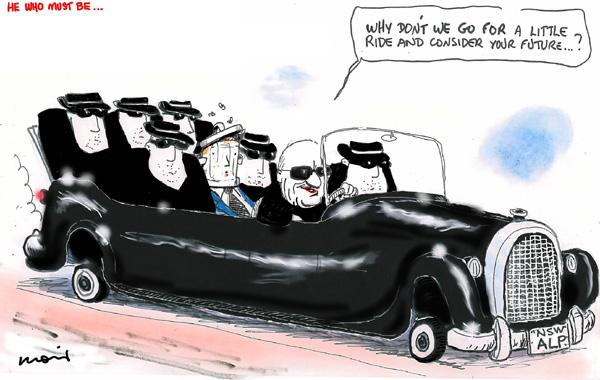
As Beverley Kingston points out in the Sydney Ideas Quarterly NSW has structural problems:
NSW is in a particularly bad position economically and structurally because of our historic dependence on coal, both as the basis of much of what industry we have left, and as an export. With coal under threat because of climate change, the NSW economy has nowhere to go. Indeed, there is a sense that a push has developed to get as much coal as possible out of the ground and sold before it is banned. ....NSW still has to recognise the implications of its historic dependence on coal.
The NSW government has run out of ideas. They are desperate.
Posted by Gary Sauer-Thompson at 8:31 AM | Comments (6) | TrackBack
August 27, 2009
a "blueprint for progress"?
In an earlier post I mentioned that I had taken time out from my photography to prepare for, attend and speak at the Future of Journalism debate in Adelaide on Monday night. The Adelaide forum happened just after the Perth one, and Tama Lever gives a good round up of that discussion, which was designed to ease journalists to step outside Fortress journalism. As Lever says news journalists in Australia are trying to figure out new, sustainable ways of plying their trade in the digital age.
Entitled a “Blueprint for progress”, the forum was organized by the Media Alliance & Walkley Foundation I never used my speech notes. My initial response to the Adelaide forum can be found in an update to the earlier post. Instead I signed up to twitter.

I was on the second panel chaired by Jonathan Este the Media Alliance’s director of communication, along with Collette Snowdon from the University of South Australia; Garry Jaffer, managing director of OMD South Australia (a media planning and advertising buying agency); and Paul Hamra, the editor and publisher of the Independent Weekly.
The panel's brief was to look into the future after the first panel of Fortress journalists had explored the changes (multi-tasking, automation, working across media) taking place in the workplace of the commercial and noncommercial print and television media institutions. The premise of the discussion was that the journalism v blogger conflict is over.
I am not going to discuss the set pieces --ie., the interviews with Tim Burrowes from mUmBrella and Stephen Brook from Media Guardian. Both talked about the world outside the citadel but the link of the new to democracy was very tenuous. What could be inferred from the set pieces is that the press had grown accustomed to silence on its fundamental aims and purposes, and that is why there is little discussion about the relationships between democracy, citizenship, public life and journalism in Australia. The inference was that such discussions were for the campus and professors, despite journalism's obvious stake in the public sphere.
One issue that surfaced through the forum was the difficulty traditional journalists were experiencing in adjusting to a digital world. This involved stepping outside the traditional journalism model to a more conversational mode of writing, using the new social media technologies of blogging, Facebook, Twitter and Flicker in the public sphere. The problem was technology, even though there is little doubt that social media is becoming a crucial part of our mediated lives.
There was a high degree of anxiety about the new technologies, despite journalists blogging, being on Facebook, and using twittering extensively. Obviously, the Media Alliance union needs to run some upskilling courses to show its members how to feel comfortable using these new technologies, and so help them to step outside Fortress journalism and start experimenting in writing journalism differently. The issue is not technology per se--it is writing journalism differently.
The fortress model is where journalism is criticized by all and in conversation with none; conventions of the craft are defended as first principles; and journalism's business is information or facts not weighty reflections. That is for professors. Journalism inside the fortress just tells it as it is, interpretation (partisan advocacy) is left to others, and it is agnostic and indifferent to policy outcomes. Therein lies a problem.
Another issue, and one not seriously discussed, was what is is to done with these tools once journalists have learned how to use them? What are they to be used for? The assumption is that they will be used in newsrooms even though these newsroom are downsizing. So where do the laid off journalists go? What do they do? Do they become independents in an emerging network culture, but are unable to make enough money online to live on. How then does the new digital technology help journalists to work outside the citadel of Fortress journalism in new media institutions?
The idea of Public (or civic) journalism was mentioned, and it was linked to the other idea of stimulating public dialogue or deliberative discussions amongst citizens on issues of a common concern to a democratic public. How this could be done in Australia was not really explored by the panel and the audience, other than the gesture to the turn to community. In that turn journalists are not only observers but participants in our political life; and they address us in our capacity as citizens within the public sphere in a media dominated environment.
There was some sense that public journalism is an idea with academic roots that is in the process of being transplanted in the soil of civil society outside the academy and outside the walls of fortress journalism. Outside the latter because it has a deep skepticism of the capacity of citizens to engage in a public discussion (eg. the vitriol of partisan/opinionated bloggers as placeholder for the herd). What was not addressed was how Fortress journalism identifies with professionals and insiders as opposed to citizens.
In this Fortress model the journalist stands as an eyewitness describing the activities of insides to a passive public, whose job it is to vote rascals/bastards in or out. Reporters act as experts and insiders and they often act as if their audience is made up of other journalists, politicians, staffers and bureaucrats. So the media is seen to talk at the public, rather than with or even to them as part of a process of considering and addressing shared problems. The Fortress model needs to be deconstructed.
Though journalists are comfortable with the public knowing what is happening, they are definitely not comfortable with using their stories and investigations to help the public take responsibility for knowing what is going on through the learned skills of conversation, deliberation and democracy. When users claim the tools as their own, the future is mobile storytelling; gaming for social change; and mapping your city according to your needs.
Posted by Gary Sauer-Thompson at 1:56 AM | Comments (10) | TrackBack
August 26, 2009
US Republicans wind things up
One current face and voice of the outraged Republican movement in America is Glenn Beck. Beck is a conservative radio and television host on Fox News, the fair and balanced network. Do have a watch Beck and the critique from The Young Turks:
Beck's comments about Obama came after the Cambridge Police Dept. and Sgt. James Crowely were publicly criticized by the president after the arrest of Harvard professor Henry Gates. Beck then broadens the attack here and here.
It is ironic that old style journalists disparage bloggers for their wallowing in opinion and vitriol in comparison to the quality of professional journalism of the traditional media institutions when we have this kind of product on Fox News designed to increase audience numbers. Or is 3.am the online future of the traditional print media-----gossip gone toxic?
Posted by Gary Sauer-Thompson at 4:24 PM | Comments (7) | TrackBack
urban violence
Though urban violence is not new it has become more visible, mobile, and common. Its contemporary public face is often bad gangsta rapper gestures and the hoodie all the way over. The Leunig cartoon refers to the drunken violence in Melbourne that is associated with the multitude of clubs and bars:
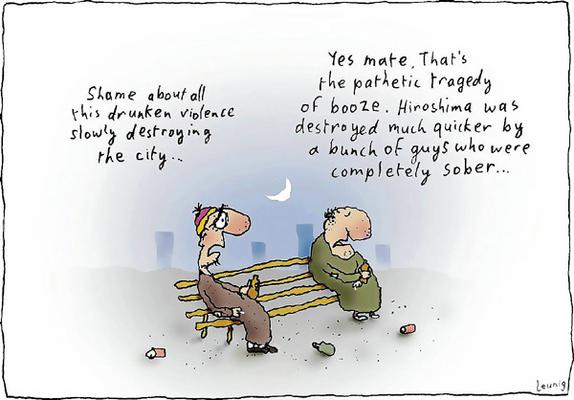
According to politicians and the press, late at night, Australian cities are transformed into ‘warzones' (even in Adelaide) where alcohol is fueling violence and thuggery around urban pubs, bars and clubs.The response of state governments across the country has been to impose ‘lockouts' upon licensed venues-bans on entering venues after a certain hour. The venues may remain open, and those inside can still purchase alcohol, but no new patrons can enter.
Guy Rundle in Crikey says:
The more casual violence of the CBD is a lot of things. Partly, it’s the old violence that used to be less visible out around suburban beer barns — many of which are now closing, as the CBD and other inner areas become the place to go. Partly it’s sheer levels of drunkenness, as spirits replace beer as the tipple of choice. Melbourne’s high levels of amphetamine use — and high levels of amphetamine in what is ostensibly ecstasy — fuel aggression. The culture of the crawl, rather than staying at one pub, increases circulation, and so on.
'Partly', is important, since alcohol is a contributing factor to violent acts. Many high-profile incidents of urban violence have involved no alcohol at all; doctors in hospital emergence wards say some assaults are not just alcohol-related, the police and prosecutors have pointed out that alcohol consumption had only a minor involvement. Rundle's argument is that a deeper cultural process going on, and one that covers both the more random CBD violence and what goes on further out.
He argues that the aggressiveness is an assertion of atomised individualism, a getting the first punch in against an indifferent world:
Far from being a generation that has it all, the kids at the station look like they don’t have much of anything. In a region stripped of manufacturing jobs, locked out of further education, effectively left to rot by a Labor government, the violence directed against Indian students is both racial and non-racial, directed against people from an international class who are going places that they’re not — trying to make a division between opportunistic and racial crimes is a false dichotomy. Often, attacking an Indian kid is simply a bonus for someone who was going to attack someone anyway.
Posted by Gary Sauer-Thompson at 8:35 AM | Comments (8) | TrackBack
August 25, 2009
Queensland: Abortion Law
Queensland is an odd place. It is the face of modern Australia as well as that of old Australia. Queensland’s abortion laws are now the most antiquated and repressive in the country. Abortion remains a criminal offence. As Professor Caroline de Costa has pointed out in Crikey:
Both medical and surgical abortion, even by registered medical practitioners, remain crimes in Queensland under legislation that uses wording from 1861...It is true that there have been no prosecutions of doctors since Dr Peter Bayliss was acquitted in 1986 but the law remains in the Criminal Code, and as the case currently before the courts in Cairns shows, the police are prepared to prosecute both a woman making a personal decision for herself, and her supportive partner.
Queensland women are now having to travel to Sydney for a medical abortion since the protection offered to doctors who perform abortions in Queensland, based on the case against Dr Harry Bayliss in 1986, only applies to surgically-induced abortions.
de Costa adds that so far the Bligh Government:
has suggested letters and words of reassurance for doctors, and some tinkering with section 282 of the Criminal Code so that there is a defence for medical as for surgical abortion. The assurances of persons currently in positions of power provides little legal certainty even while those people remain in their posts, and none whatever when they depart.
Premier Bligh did say on Q+ A that her personal view is that abortion should be a matter between a woman and her doctor. However, she quickly added, there shouldn’t be any attempt to change the existing law because there wouldn’t be the numbers in the Queensland Parliament for it to get through.
So there is to be no decriminalisation of abortion in Queensland under a Blight Government. Something needs to be done. As Andrew Bartlett points out the situation for individual women seeking an abortion and for doctors prepared to provide is now totally untenable. Beirne School of Law Associate Professor Heather Douglas at the University of Queensland said:
Studies suggest that around 80 percent of survey respondents agree that a woman should have the right to choose whether she has an abortion. For many women - and for the health budget- abortion using drugs is a safer and cheaper option. As a result of the current legal position, there is virtually no access to abortion through the public hospital system in Queensland. This means that abortion in Queensland is also a class issue. Women with greater access to funds are more able to travel to obtain an abortion and to pay the private medical fees associated with abortion.
The ethical point is that woman should never be prosecuted for undergoing abortion, that the decision about abortion should be between the woman and her practitioner; and the regulations covering abortion should be in the health regulations in the 21st century.
What now? Women should be able to access safe legal abortion and should not have to suffer further indignities and possible penalties because she has sought and had an abortion performed.
Posted by Gary Sauer-Thompson at 2:55 PM | Comments (10) | TrackBack
August 24, 2009
Future of Journalism Forum in Adelaide
The Future of Journalism movement is having a forum in Adelaide tonight at the ABC Studios, just after it had rolled through Perth. The forum is entitled Blueprint for Progress, and it looks to be an interesting forum with lots of space for discussion.
I don't know how the Perth discussion went but my gut feeling is that newsrooms of the traditional media are unhappy places. This Moir cartoon can be interpreted as applying to journalism, given all the downsizing currently taking place.

I mentioned the forum on an earlier media post What I didn't say then was that yours truly will be a member of panel 2, The changing landscape. My talk notes are here on philosophy.com.
The two panels are structured in the following way. Panel I, entitled The changing workplace, is primarily concerned to get some idea of how journalists’ lives and work environment are changing. To what extent is convergence rewriting the skills manual – what new skills should journalists be learning and what should be provided on-site? Are journalists working longer hours? Covering more stories in any one day?
Has the traditional face-to-face interview largely been replaced by the telephone and email? What of quality: how important are the old skills of accuracy and concise writing? Are time pressures having an adverse affect in these area?
The key question for Panel 2, The changing landscape, is about charging for content – will it work, and what sort of content will people pay for? What sorts of niches are there out there ripe for exploiting by people with journalists’ skills who understand new technology? What sorts of funding models might work in the changing news landscape?
How can journalists add value to what they have traditionally done? Will “citizen journalism” play a major part in keeping the public informed and, if so, will this displace the traditional news media? How important are social networking tools to the news media: crowdsourcing, marketing, etc?
The Media Alliance's weblog Wired Scribe, which was run by Jonathan Este and attached to the Future of Journalism site, appears to have been replaced by the The Debate on the Future of Journalism site. They have added a No journo No News site. They are doing their bit to foster debate and discussion amongst their members. This post sums up the current state of debate on the charging for content issue.
Trouble is there is not much of a debate happening within journalism, judging by the lack of comments from journalists on The Debate weblog.
Update
The national context of the forum was Fairfax's $380 million loss for 2008-09, weighed down by operating earnings fell 27 per cent to $605 million, with the metropolitan newspapers the hardest hit. Fairfax have little idea about top-line growth in a digital world as they are still locked into seeing their staff as a cost centre to be constantly trimmed, rather than as the engine room for their next brilliant idea.
Understandably, the atmosphere of the forum was rather depressing if one read the body language of the industry people on the first panel, and there seemed to be a reluctance amongst journalists to step into a digital world and develop their own blogs. Journalism as writing and image making (video) was assumed to be information rather than the interpretation of information and events; the insider/outsider distinction between journalism and bloggers was assumed; and the fall in advertising revenues was attributed to the global financial crisis on advertising revenues, not the shift of advertising online. Digital advertising is still in its early stages according to the advertising people especially with local targeting, tailored to specific readers.
The journalists are in shock rather than being recovering journalists. Nothing like GrowthSpur was mentioned to facilitate the shift to web based journalism. It was bootstrap stuff----each media organization finding their own way into web journalism constrained by their resources.
In the satellite feed from London, Stephen Brook from Media Guardian, ruled out a pay wall saying that the Guardian News and Media group is exploring other ways to create new revenue streams, such as membership, and looking at a variety of potential partners and vendors (eg., festivals such as Glastonbury.)
There was no mention at the forum about news photography or photojournalism --- visually covering daily news events-- being finished.
Posted by Gary Sauer-Thompson at 1:26 PM | Comments (8) | TrackBack
Techport Australia
Techport Australia in Osborne, South Australia, is the home base for the $6 billion Air Warfare Destroyer (AWD) project and the construction base for the Royal Australian Navy's next generation of submarines. According to the Rann Government this AWD platform is being developed into Australia's largest naval shipbuilding hub. Establishing infrastructure that would support multiple users (a "common user" hub) to attract leading defence companies from around the world to Adelaide would help SA win more defence contracts and jobs.
One possibility that is being lobbied hard by the Rann Government is for the US Navy to use this Port Adelaide shipbuilding centre as a repair base for its warships. Currently, the US has repair bases in Japan and Singapore. So whip up the threat of the North Koreans missiles and nuclear warheads to show that South Australia is a safe and secure location.
The salt marsh of the nearby Mutton Cove Conservation Reserve doesn't stand a chance when the Rann Government eyes the possibilities of a future $100 billion in contracts. Economic development rules in the Defence State----there is no doubt about that. It's full seam ahead.
SA is hungry for defence industry work, and this is all about networking, the arms industry exploiting the maximising business opportunities and backroom policy making. Where is the ecocriticism of the development and growth of defence and sustainable defence industries by those dismissed by the Rann Government as “feral low-life”.
Surprisingly, there is little public presence from the neo-liberals. Their big concern about the dominating state and the road to serfdom, does not target a military-industrial complex in formation, despite the threat of this complex endangering our liberties and democratic processes.
The military-industrial complex is a tough nut to crack and it requires a non-stop diet of external threats to keep the capital accumulation process going, with its associated moral hazards and rent seeking. Even if you come at the criticism of this complex from the waste angle--due to "front loading," defense contractors overpromising results, underestimating costs, and profiting from continuous, costly modifications----you are still open to accusations of being "soft on terrorism" and appeasement.
Posted by Gary Sauer-Thompson at 8:47 AM | Comments (2) | TrackBack
August 23, 2009
backlash against Obama
In his Obama’s Trust Problem in The New York Times Paul Krugman refers to news reports that the Obama administration — which seems to be backing away from the “public option” for health insurance — is shocked and surprised at the furious reaction from progressives. Krugman adds:
A backlash in the progressive base — which pushed President Obama over the top in the Democratic primary and played a major role in his general election victory — has been building for months. The fight over the public option involves real policy substance, but it’s also a proxy for broader questions about the president’s priorities and overall approach.
Progressives are now in revolt. Obama took their trust for granted, and in the process lost it. And now he needs to win it back. Krugman's argument here is similar to what is happening in Australia. There the Rudd Government is losing the trust of progressives due to its very watered down climate change policy, priorities and overall approach to energy.
Krugman's argument is part of an ongoing debate in the US about the politics of health care. "Change" is what Obama stood for. "We can do it" Change sure was needed in health care.
Glenn Greenward says that:
The central pledges of the Obama campaign were less about specific policy positions and much more about changing the way Washington works -- to liberate political outcomes from the dictates of corporate interests; to ensure vast new levels of transparency in government; to separate our national security and terrorism approaches from the politics of fear. With some mild exceptions, those have been repeatedly violated. Negotiating his health care reform plan in total secrecy and converting it into a gigantic gift to the pharmaceutical and insurance industries -- which is exactly what a plan with (1) mandates, (2) no public option and (3) a ban on bulk negotiations for drug prices would be -- would constitute yet another core violation of those commitments, yet another bolstering (a major one) of the very power dynamic he vowed to subvert.
Obama does need to toughen up given that the standard practice of the private medical insurance companies in the US is to kick people off their coverage when they get sick; to deny coverage to people who have previously been sick; to hide lifetime limits in the fine print, force people into bankruptcy if they face a serious illness; and to discriminate against pregnant women and their families. Their strategy is to squeeze every dollar they can out of patients in the current system, up until the last possible day they can.
Posted by Gary Sauer-Thompson at 2:10 PM | Comments (13) | TrackBack
August 22, 2009
more Murdoch
The Los Angeles Times reports that News Corp is trying to organise a consortium of online news providers. Paywalls will only work if everyone does it, so they might as well organise it properly.
The notion of charging for digital access to news, either online or on devices, has been gaining momentum ever since the Associated Press' annual meeting in San Diego in April. William Dean Singleton, chairman of the AP and chief executive of MediaNews Group Inc., railed against the "misappropriation" of news on the Internet -- a reference widely interpreted as a swipe at search giant Google Inc.
Neat idea, misappropriation of the news. How can you misappropriate news? A newspaper, yes, but news?
A consortium of newspaper publishers is bound to attract scrutiny from federal regulators, who would seek to determine whether it reduces competition, said antitrust attorney Robert W. Doyle Jr., a partner in the Washington law firm of Doyle, Barlow & Mazard."The antitrust concern arises if there's no pro-competitive reasons why they have to get together," Doyle said. "If there is a pro-competitive benefit, that's weighed against the anti-competitive problem of allowing competitors to get together."
It would be interesting to know how Australian federal regulators would respond, other than slowly.
I originally found this at the ABC website. So if the ABC takes out a subscription with this proposed news consortium, and they broadcast or post the news they find there, will the ABC be misappropriating the news?
And if I take out a subscription and get a bit of news, and tell my neighbour and a couple of my Facebook friends and maybe one of them has a Twitter account and a big following and eventually the whole world knows about it for the cost of my one subscription, would we all be misappropriating the news? Or would that be an uncompetitive monopoly of some kind?
Posted by Lyn Calcutt at 10:53 AM | Comments (12) | TrackBack
August 21, 2009
Canberra gaze: Coalition wedged
The Coalition is successfully self-destructing over climate change. By playing hard ball politics on the emissions trading scheme (the wedge) the Rudd government has successfully fractured the Coalition.
The Nationals are off on their own as their diehard climate change sceptics prepare to die in the ditches. The conservative western Australian Liberals have adopted the tactic of internecine conflict with their fellow Liberals. Many of the other conservatives enjoy seeing Malcolm Turnbull's carcass swing in the breeze.
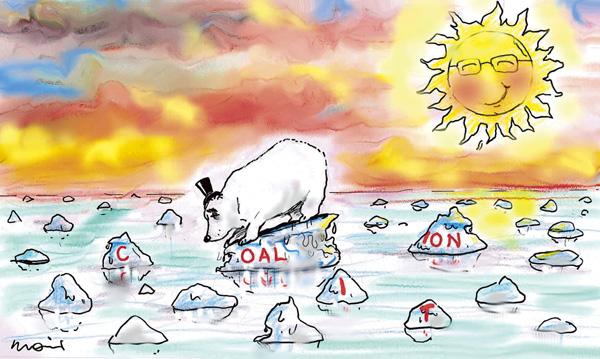
The Coalition will be out of power for a couple of elections, if not a decade because its self-destructive tendencies are making the party electorally unattractive. They are in the grip of a death wish. The dinosaurs and relics from the past have yet to grasp the significance of environmental politics for Australia's economy; they think that acting as the mouth piece for the interests of the old polluting energy industries and King Coal is clever politics; and they still cling to the myth of unfettered growth.
The political reality is that the political taunting by Rudd + Co have reduced them to a shambles during in Question Time, an their twisting and turning to avoid the sharp edges and pincers of environmental politics indicates that they have little understanding of the relationship between the economy and its environmental support systems. The days of unfettered growth, the exploitation of nature by an unregulated capitalism are over, now that it is realised that the externality of global heating caused by economic growth fueled by electricity generated by fossil fuel represents a massive market failure.
As the economists say, the climate is the quintessential "commons," the public good that is free to everyone, and therefore valued by no one. But even now that we understand its value, and the risks of continuing to overburden it, the market cannot possibly fix the problem of its own accord. It is simply incapable of factoring in the very long-term costs and benefits, of giving them sufficient weight, to drive the investments that are needed in the short-term. That is why government must give it direction. But given the right direction and the right incentives, harnessed instead of stifled, the market can be a very powerful force for climate protection. the new rules of the market is that the climate will stop being free. There will be a cost for emitting carbon.
The response of the dinosaurs is that Australia cannot afford an emissions trading scheme or to reduce greenhouse gas emissions to prevent global overheating now. Jobs will be lost. Industries will go off sure. Yet the economic models so far do a poor job of projecting how rising energy prices will lead producers or consumers to substitute other goods and services; how price signals will drive new technology and innovation; or how businesses will respond to changes in policy. The models also have a difficult time weighing the near-term costs of emission reduction against the long-term benefits of avoiding climate change impacts.
Posted by Gary Sauer-Thompson at 12:14 PM | Comments (12) | TrackBack
Cubbie Station: up for sale
The Cubbie Station cotton farm, located near Dirranbandi, Queensland, is up for sale for $450 million. It has has been financially hammered by the drought. The station, which was created by amalgamating 12 floodplain properties to give Cubbie a total of 51 water licences, siphons off an enormous amount of water from the Murray-Darling system --it has 70 gigalitres of water licensed for extraction and 538 gigalitre storage capacity. That's a difference of 468 gigalitres that is siphoned off.
Should Cubbie Station be part of the Commonwealth water buyback program? Or should the Commonwealth's emphasis be on bringing Queensland into line over those 468 gigalitres?
Cubbie Station exemplifies all that is wrong with the management of water by the states. Cubbie Station's access to water is based on a 70GL extraction from the Balonne River, and the remainder -- 469GL -- comes from "unregulated, unlicensed, unmetered, free" overland flows. This system enables Cubbie Station to boast about the small amount of water that it takes from the Murray-Darling system. The overland flow from the floodplain would, if undiverted, enter the Balonne and Culgoa Rivers. Cubbie draws off up to half of every flood in the catchment, preventing it from entering the Balonne-Culgoa.
Recently, on Lateline Senator Bill Heffernan points to how the Bligh Labor Government in Queensland plans to deal with the situation:
Under the proposed resource operating plan for the Lower Balonne under the proved operating plan for the lower Balonne there's a proposal in the case of Cubbie to issue a license for 469,000 mega-litres of water, which will also include a neighbour downstream on that licence...the licences that are now proposed to be issued will be issued on the basis of the size of the bulldozer used and storages produced by that bulldozer and the banks to intercept the overland flow ... there was legislation passed in the Queensland Government so that they were exempt from any environmental planning as long as the storages were kept under five metres in an area...which has 2.5 metres of evaporation.
In effect the vast majority of Cubbie’s diversion remains unlicensed. Heffernan argues that what should happen is ending its vast and unsustainable diversion of overland flows, not who owns the property.
The water licences proposed under the draft plan are not sustainable and they shouldn't be issued. The trouble here is that Queensland couldn’t care less about the health of rivers either on their side of the border or beyond. They continue to trot out the line that they take only 5% of water from the Murray-Darling. It’s literally correct — that’s what they take out. It’s what they prevent from entering the Condamine-Balonne region of the Murray-Darling system from run-off that is the key.
Heffernan says that:
The water licences proposed under the draft [Queensland] plan are not sustainable, they shouldn't be issued. If the Commonwealth wants to buy back Cubbie Station, it should only allow Queensland to issue licences at a level that's sustainable and could continue to be farmed.
However, the Federal Government doesn't have the power to stop the Queensland plan to issue a license for 469,000 mega-litres of overland water. As Heffernan says:
The flaw in the present scheme for the new body that's been set up to man control of the Murray-Darling Basin has one flaw in it: that is every state has a veto power for some years to come yet on changing the proportion of water flowing out of that state.
The Queensland Government — regardless of political orientation — simply doesn’t care about anyone downstream.That is what needs to change. The state's veto on water management of the Murray Darling Basin is akin to the fox guarding the chook house. The Commonwealth should only allow Queensland to issue licences at a level that's sustainable.
Posted by Gary Sauer-Thompson at 7:45 AM | Comments (6) | TrackBack
August 20, 2009
Skeketee: the politics of health reform
Mike Steketee in Stumbling blocks on the journey to better health in The Australian highlights the key proposals of the National Health and Hospitals Reform Commission's final report. The recommendation is for the commonwealth to take full responsibility for primary healthcare, including presently shared responsibilities such as dental and aged care, as well as community services such as alcohol and drug treatment and mental health now run by the states.It suggests a shift away from fee-for-service medicine, which pays doctors for quantity rather than quality, to increased use of payments that reward outcomes or pay for the overall care for patients with chronic conditions.
Steketee argument is that though Kevin Rudd sounds deadly serious about wide-ranging reforms in health the question is whether the system, the politics and the economy will allow him to make them.
He does not sound like someone who has given up on health reform. But with the states already baulking over increased commonwealth responsibilities, it is hard to see how true health reform is compatible with the co-operative federalism in which Rudd has invested so much effort, unless a big commonwealth bribe to the states can do the trick.
Steketee adds that the National Health and Hospitals Reform Commission's final report caused relatively little offence, with a muted reaction so far from the AMA and supportive noises from the private health funds. That Rudd did not want the commission to look at the 30 per cent private insurance tax rebate helped with the politic.
Steketee's judgment is that the final report:
leaves an obvious gap: although the report dwells on growing pressures on health from increasing demand, technological advances and ageing, and says the system has reached a tipping point that requires tough decisions, it ignores the $4bn a year or more spent on subsidising private health insurance, the most inefficient use of government resources anywhere in health and an amount that would make a big difference if it were spent directly on hospitals, whether public or private. Talk about the elephant in the room.
We can put aside the rhetoric about "fundamental root and branch reform". This will be evolutionary change within political limits. of the possible.
Posted by Gary Sauer-Thompson at 12:37 PM | TrackBack
August 19, 2009
spruiking nuclear power
The nuclear power debate in Australia in the context of energy security and climate change has been, and is, rather facile. It is mostly framed by publicists such as Ziggy Switkowski as nuclear power is the only greenhouse option for baseload power. This is coupled to an opposition to renewable energy, such as wind and solar, which are dismissed as cottage industries. The rhetoric of these nuclear enthusiasts is that nuclear power is the real thing--a big centralized technology that is the magic bullet to reduce greenhouse pollution. A "nuclear renaissance" is coming is their message.
One such publicist/spruiker is Bob Hawke, our ex-PM. Noting that Australia will be supplying the international nuclear power industry with uranium exports for decades ahead, he says:
Australia can make a significant difference to the safety of nuclear generation by agreeing to take waste from nuclear power stations. This would be an important contribution to safety and energy security. It would also become a strong source of national income for Australia that could be dedicated to our own environmental and water requirements.The fact is that Australia has some of the geologically safest places in the world to act as a repository for nuclear waste...the financial benefits from any decision would be immense.
Making money from storing toxic material with a long afterlife is having a death wish. Hawke needs to do a bit of research on Australian public opinion to back his plugs for going nuclear and to stop the big forgetting about Maralinga.
Not to be outdone in the enthusiasm stakes, Paul Kelly targets renewable energy in the form of renewable energy targets (ie., 20 per cent of electricity by 2020) because they will lead to higher electricity prices. Yet electricity generated from coal will become more expensive with a cap and trade scheme in place, even though the Rudd Government's CPRS is dismal policy and will not shift consumer behaviour because the price of carbon is set far too low. That is renewable targets are needed! Kelly then adds:
Nuclear power is not financially viable for Australia at present...The truth is that Australia is banking on clean coal and gas, the two present baseload technologies. It is making a commitment to test whether carbon capture and storage can be proved at scale and on commercial terms. Coal and gas reflect our comparative advantage. Establishing a nuclear industry from the ground up would be an enormous and improbable task for Australia. The point, however, is that it should be assessed, now and in future, on economic grounds not on political prejudices from another era.
If nuclear power is not financially viable for Australia at present, and establishing a nuclear industry from the ground up was such an enormous and improbable task , then why bother to assess it?
Whose political prejudices are we talking about? Isn't it the nuclear industry that wants taxpayers to foot the bill for costs like reactor decommissioning, insurance and long-term waste management? Some argument is needed, if Kelly is appealing to reason in opposition to those opposed to nuclear power on the basis of mere emotion and prejudice. No such argument is given by Kelly. He's spruiking for the industry and he doesn't mention that the massive growth in photovoltaics that we have seen worldwide saw it surpass nuclear in 2006; or that renewables already provide 14 per cent of German electricity, and the percentage is growing quickly.
Paul Howes, the national secretary of the right-wing Australian Workers Union, in a speech about energy policy for Australia at the Sydney Institute entitled Energy Choices For The Future promises more in the way of an argument. He makes his pro-nuclear power industry stance clear:
The present Government prohibits on these shores a nuclear power industry. It says we do not need nuclear power as a part of the mix because we have fossil fuel and renewables to spare....A domestic nuclear industry could potentially be up and running within ten to fifteen years, but despite a rising level of community acceptance according to a number of recent surveys, with constraints to be addressed regarding safety, waste, proliferation and the risk of diversion, of this worthwhile idea, some Governments, overtly at least, are against it ... We currently have no domestic processing capacity and would therefore need to rely on the development of a domestic nuclear sector to process uranium ore that is suitable for use by reactors. Which means we should consider the establishment of nuclear processing facilities in Australia --- to add value to our export ore and oxides.
Howe states that the fifteen year time frame will ensure that nuclear energy has a role in achieving significant emissions reductions targets by Australia by 2050. This is a technology available today, which can act as insurance against the uncertainties of the technologies of tomorrow as well as a way of maintaining living standards and securing wages.
That is his position. What is Howe's argument for developing this problem creating form of energy? There is an appeal to the authority of the Lenzen review' commissioned by the Australian Uranium Association and that is it. We should just take the word of the uranium miners! Howe is their publicist--it's a jobs and money sell for mates. Nor should we be surprised, as that is what he has basically has been doing in the energy debate around the shift to a low carbon future. What he doesn't advocate for is the jobs in the emerging renewables industry.
For an argument about the possibilities of nuclear power we need to go to this post on Barry Brook's BraveNewClimate.com. There we find an argument for Integral Fast Reactor (IFR) nuclear power that addresses the problems of nuclear power.
Posted by Gary Sauer-Thompson at 2:59 PM | Comments (11) | TrackBack
Afghanistan: continued war and destruction
The western media talk around Afghanistan is about the forthcoming presidential election, security, and the Taliban's intensifying military attempts to disrupt the presidential election or the forthcoming summer of violence. What of the longer term military strategy? It looks to be more of the same: further increase in US troops, a military surge, use of armed drones in west Pakistan and southern Afghanistan and more targeted assassinations with a "war on drugs".
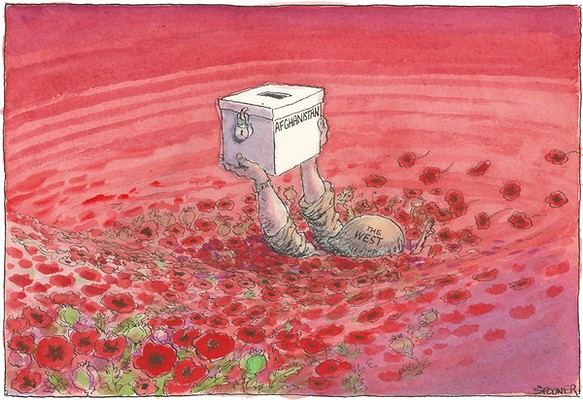
That this war has been going on for nine years and there has been an escalation in the cycle of violence in Afghanistan, not an end to it. It has resulted the greatly improved capabilities of the Taliban paramilitaries. The neo-Taliban has two non-negotiable demands: the withdrawal of all foreign troops and a greater role for religious law in framing Afghanistan's legal and social structures. This indicates that it is no longer possible for western states to occupy countries in the middle east and southwest Asia.
The United States and its Nato allies have ended up in an Afghanistan quagmire and are now mired in Afghanistan. Time for a rethink---disengagement. How will that be achieved? A broad-based post-election consensus government that brings some of the Taliban into the Afghan government? That will be difficult as the Afghan body polity increasingly splits on ethnic lines.
The current US strategic rationale for an increased commitment in Afghanistan is the fear that if the Taliban isn't defeated in Afghanistan, they will eventually allow al Qaeda to re-establish itself there, which would then enable it to mount increasingly threatening attacks on the United States. The question should be asked: is the war in the interests of the U.S. and its allies?
The neo cons and military establishment in Australia give the impression that the enemy that the U.S. and its allies are fighting in Afghanistan are dedicated jihadis seeking to overthrow Arab monarchies, establish a Muslim caliphate, or mount attacks on U.S. and Australian soil. Their “safe haven” argument consistently downplays the insurgents concern with local affairs---eg., the political disempowerment of the Pashtuns and the illegitimate foreign interference in their country.Secondly, the argument assumes that the US, as a unipolar power has the power to reshape international relations.
Posted by Gary Sauer-Thompson at 7:55 AM | Comments (1) | TrackBack
August 18, 2009
newspapers resisted the internet
Bill Wyman at Hitsville has begun a series of articles on the reasons why Why Newspapers are Failing at Splice Today. He has five reasons for this and so far he has uploaded two: the collapse of newspaper's business model as advertisers desert newspapers for the internet, and the culture of the newspapers.
As the former is well known I will concentrate on the latter. Their culture is that of a monopolists and their history of being their reader’s de facto window to the world was just a quirk of their monopolies that made them that. Google desktop enable readers to develop their own home pages. Secondly, the newspapers did understood the web, grasped its service power, or recognized that an enormous sea change was taking place.
Wyman's argument is that journalists aren’t too clear-eyed and often aren’t too intellectually honest) when it comes to analyzing the collapse of their own profession. He says there were a number of things newspapers plainly needed to do in relation to the seachange:
Most of all they needed to stake their place in the new informational channel that was going to change our world. They had to shift their coverage to a new, tech-savvy generation. They needed new equipment to share in the experience of that generation, undergoing the biggest sociological shift since the 1960s. They needed to learn the new era’s tools, experiment with and test a new medium, take advantage of its speed and immediacy to take their place in society even deeper into peoples’ lives. They needed to take a look at their work rules and union agreements to make sure they didn’t the hamper the evolution of their industry at a time when it could be facing mortal danger.
The truth is, newsroom staffs are permeated with fear of change and a discomfort with new technology. At bigger urban papers, parsimonious bosses, unions and work rules made the transition even more difficult.
This reason for newspapers failing applies to the regional newspapers in Australia as they have a very limited presence on the web, and their strategy has been one of cost cutting and containment. In other words there was no strategy to adapt newspapers to the enormous sea change. Cost containment and reducing debt is still the "strategy" of Fairfax under Brian McCarthy. So we have their lost cost Independent Weekly as competition to The Advertiser; so low cost that it has a minimal internet presence.
Wyman says that the criticism of Google News from publishers is flawed because the top 20 daily newspaper companies in the country could have built a similar site with a paltry investment 15 years ago. They didn’t, of course, for three reasons:
• No one understood the technology or its implications, and if they did lacked the skills to situate their companies competitively;
• They didn’t think they had to;
• And, most importantly, after decades of monopoly control, they had forgotten to care about the convenience of readers in the first place.
Those three bulleted points amount to a polite way of saying they were out of their depth, lazy, and arrogant.
Posted by Gary Sauer-Thompson at 7:50 AM | Comments (9) | TrackBack
August 17, 2009
30-year draft Plan for Greater Adelaide
As noted earlier the 30-year draft Plan for Greater Adelaide was recently released for public consultation. The draft says that it returns to some of the principles of Colonel Light’s plan, such as the concept of a balance between nature and the city, by expanding the network of parks and greenways to encourage walking and cycling and to provide more shade to urban areas.
It sounds good--too good. Now I have been photographing along the Port River estuary on the LeFevre Peninula, which has been subject to pollution from heavy industry, and is a local example of the immense damage Australia has done to its own environment through its own actions. So I turned to Northern LeFevre Peninsula Masterplan to see how it exemplified the Greater Adelaide Plan's proposal for the network of parks and greenways.
The Peninsula Masterplan says that after extensive community consultation:
an additional 62 hectares of land on the Lefevre Peninsula has been rezoned for defence, infrastructure and port-related industry to meet demand generated by the State’s success in attracting the billion dollar Air Warfare Destroyer contract and major infrastructure developments in the region.
Well, that puts the development priority upfront.
The reality is that the Lefevre Peninsula is one of the state’s three key areas for future industrial land development due to its significant export function, the extent of its infrastructure and the amount of industrial land available. The ecological values of open spaces, wetlands and saltmarshes are little more than an afterthought. The open spaces are just minimal ideas.
The masterplan goes to say that the Northern Lefevre Peninsula Development Plan Amendment creates:
a framework for the integration of new industry with the natural landscape, including an open space corridor from the coast at North Haven to Mutton Cove on the Port River. It recognises the need for buffer zones and open space to maintain the integrity of the environment, protects areas of significant biodiversity and provides stormwater management policies.
However the Development Plan Amendment frames the area as one of having "a significant opportunity to contribute to a well planned and integrated industrial cluster to support defence and port related activities that will further contribute to employment and economic growth for South Australia, and to the provision of infrastructure and enhancement of open spaces on the Peninsula for the benefit of the community and the environment."
The majority of vacant land on the northern Lefevre Peninsula is held in State Government ownership and vested with Defence SA. Defence SA is responsible for delivering South Australia’s Defence Industry Strategy, including the State Government’s commitments to the Royal Australian Navy’s $8 billion Air Warfare Destroyer (AWD) project; and ensuring the sustainable development of a defence and port-related industrial precinct on the northern Lefevre Peninsula. This is the face of SA as a defence state.
Posted by Gary Sauer-Thompson at 8:36 AM | Comments (2) | TrackBack
August 16, 2009
America in turmoil
The context of the current debates in the US over public health insurance and health care is the Clinton administration's health reform debacle; the profound divisions among current Democrats in Congress (conservative, "Blue Dog" Democrats) over how to pay for health reform and how control costs to the inclusion of a public insurance option; and the refusal of the insurance industry to end the controversial practice of "rescission."
Under rescission, insurers retroactively cancel—often on the basis of dubious claims that policyholders haven't disclosed their complete health histories—the coverage of those who develop expensive medical conditions. That has left many people with costly medical bills for treatments that had been previously authorized by their insurance.
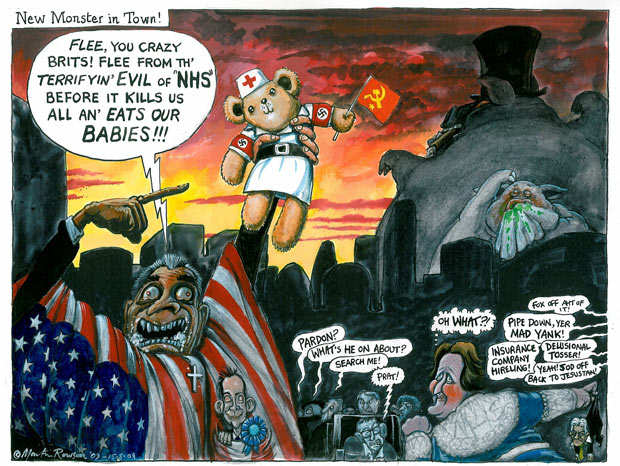 Martin Rowson
Scare talk about big government and threats to free enterprise is always present in debates about providing, financing, and regulating American health insurance. Paul Waldman at American Prospect argues in All the Rage Over Health-Care Reform that though the present anger of the American Right is being thrown at the administration's attempt to reform health care, that rage goes much deeper than any one policy; and that should the health-care plan fail, it will continue to simmer unabated. since they have a deeper undercurrent in the polity.
He says:
What gives the conservative pundits' their message all the more power is that this shocking transition happened at a time of economic misery, when more and more people are suffering. Even those who haven't lost their jobs are worrying more about their economic future than they ever have before. People are afraid and uneasy, and some of them have the growing feeling that something just isn't right. It isn't just the economy. It's everything they see around them, in a society that becomes more complex and inscrutable all the time, where the traditional arrangements that gave order and hierarchy and predictability to the world and their place in it are breaking down. It's more than the knowledge that some pencil-pusher could lay them off at any moment. It's kids who don't respect their elders. It's walking down the street and hearing people speaking foreign languages. It's everything that makes them feel threatened and uncertain and out of place.
And when they turn on their radios and televisions, they find a kind of order. I know what you're feeling, they are told, and I can tell you at whom you ought to be mad, so let's yell and scream and fear and rage together. It isn't your boss; it isn't Wall Street,. No, it's a new administration and the people it represents, the people who made you into a minority of all things, the people whom we can turn into an amalgam of every enemy you've ever hated. It's them.
Posted by Gary Sauer-Thompson at 8:48 AM | Comments (7) | TrackBack
August 15, 2009
crazy people
If the antics we've seen over climate change and the CPRS is as loony as Australian politics gets, we should count ourselves lucky. Nothing we produce here can hold a candle to the American right. Nothing that wouldn't count as certifiable, anyway. They make Steve Fielding and Wilson Tuckey look like finishing school graduates.
Obama's proposed health care reforms have them in a frenzy, dragging the British NHS system into their personal debacle. It's been claimed that if Stephen Hawking had presented to the British system he would have been written off as a hopeless case and left to die. Never mind that it turned out Hawking is British and owes his life to the NHS, the scare is out.
There's talk of something they call 'death panels', whereby the elderly will be deemed expendable and given a nudge into the grave by government. Well, according to Sarah Palin, they will anyway. Sarah didn't make 'death panels' up all by herself. It's a leftover of the conservative arsenal against Clinton's health care reforms.
Another Republican meme doing the rounds escaped from a more friendly owner to end up plastered all over the American landscape in modified form.
Obama's not having much luck dealing with the lunacy. When town hall meetings organised to explain the scheme were hijacked by screaming loonies, the solution was to have Obama do a few, the idea being more or less 'look me in the eye and say that'. But when he tried, they didn't turn up.
Paul Krugman :
The truth is that the factors that made politics so ugly in the Clinton years — the paranoia of a significant minority of Americans and the cynical willingness of leading Republicans to cater to that paranoia — are as strong as ever. In fact, the situation may be even worse than it was in the 1990s because the collapse of the Bush administration has left the G.O.P. with no real leaders other than Rush Limbaugh.
He thinks there's no point carrying on the diplomatic approach with such people. Obama needs to simplify the message and drive it home. His commenters beg to differ. They say it's time to start pointing out what lunatics these birthers and tea party people really are.
In comments over at Club Troppo, Ken Lovell says:
Our Great and Powerful Friend, our ally and protector, has become a fractured and dysfunctional society that increasingly tries to promote and protect its self-identified global interests by the use of crude force. On any objective analysis it is a deeply disturbing situation that can only get worse. Yet hardly anybody wants to talk about it or even admit there is a problem.
Luckily our great and powerful friend can't inflict its fractured and dysfunctional health system on the rest of us, although its interests do attempt to burden us with its insane politics. This kind of stuff is bad for American society, and invariably works to the disadvantage of the crowds who tend to support it. But what's bad for them can be good for us. Watching both the antics and the state of the American health system, we can be grateful that Wilson Tuckey is as bad as it gets here, that at least Barnaby Joyce is funny, and that we know the benefits of Medicare.
Posted by Lyn Calcutt at 3:41 PM | Comments (9) | TrackBack
August 14, 2009
media democratization?
Around a month ago the School of Culture and Communication at Melbourne Uni held a conference entitled “Journalism in the 21st Century: Between Globalization and National Identity”. All we have to on are the abstracts of the papers to help us explore the significance of the set of shifts from mass communications media to the emergent media environment.
The abstract that caught my eye was by Terry Flew from the Queensland University of Technology, called, Democracy, Participation and Convergent Media: Case Studies in Contemporary News Journalism in Australia. It says:
The shift from 20th century mass communications media towards convergent media and Web 2.0 has raised the possibility of a renaissance of the public sphere, based around citizen journalism and participatory media culture. This paper will evaluate such claims both conceptually and empirically. At a conceptual level, it is noted that the question of whether media democratization is occurring depends in part upon how democracy is understood, with some critical differences in understandings of democracy, the public sphere and media citizenship. The empirical work in this paper draws upon various case studies of new developments in Australian media, including online-only newspapers, developments in public service media, and the rise of commercially based online alternative media. It is argued that participatory media culture is being expanded if understood in terms of media pluralism, but that implications for the public sphere depend in part upon how media democratization is defined.
What is meant by media democratization? Or media citizenship for that matter? Fortunately Queensland University of Technology has a digital archive under a common licence, and Flew's paper can be found there.
What we learn is that the media democratisation refers to the free, user-generated content created by the emergence of by the Web 2.0 revolution. Flickr is an example. It decentralizes power, erases the old distinction between professional and amateur, and gives rise to a participatory visual culture. A participatory media culture emerging with blogging in a mediascape dominated by the cultural industries enables citizens to:
have access to a wider range of information sources, to produce and distribute their own media in greater numbers, and to have greater autonomy from agencies of the state or large-scale commercial media enterprises in doing so...The important category in terms of public sphere theory is that of voice, which points in various ways to the opportunity to participate in public discourse, the capacity to use communications media to persuade others and shift public opinion (what Hirschman termed the ‘art of voice’), and the ability to use such media to achieve influence over politics and public affairs.
Posted by Gary Sauer-Thompson at 5:13 PM | Comments (3) | TrackBack
Canberra Gaze: national security laws
The Attorney-General, the Hon Robert McClelland MP, recently released a Discussion Paper for public discussion on the proposed legislative reforms to Australia’s counter-terrorism and national security legislation. The context is that here hasn't been a terrorist episode in Australia and there has been effective law enforcement under the existing laws
He said that:
the amendments proposed in this Discussion Paper seek to achieve an appropriate balance between the Government’s responsibility to protect Australia, its people and its interests and instil confidence that our laws will be exercised in a just and accountable way...The Government has endeavoured to address the concerns and issues raised by recent important reviews of national security and counter-terrorism legislation with a view to achieving the right balance between strong laws that protect our safety whilst preserving the democratic rights that protect our freedoms.
The Discussion Paper is difficult as it consists of amendments to various acts and its audience is more lawyers than anyone else. It is good to know that Rudd Labor acknowledges that citizens in a liberal democracy have democratic rights and freedoms. I wonder what rights these are?
Richard Ackland in the observed in the Sydney Morning Herald that:
The paper seems to be about softening a few things at the edges (for example, limiting the time someone can be held without charge to seven days) and cranking up other powers (no need for warrants in certain circumstances, the expanded definition of terrorism and new offences dealing with hoaxes and incitement).The Government is selling this as a balance between the rights of citizens and the security of the nation but, overall, there is much more cranking up than watering down. None of which guarantees that, if you have wider definitions and more powers, detection and prevention become more effective.
There is a proposal to allow police to conduct searches without warrants or judicial oversight where there is a ''material'' threat to public health or safety and a seven-day cap on detaining suspects without charging them. How is that balanced? Balanced by what? My rights?
Posted by Gary Sauer-Thompson at 1:42 PM | Comments (3) | TrackBack
August 13, 2009
shifting to sustainment
A key issue for us today is how to make the shift from unsustainability – the dominant condition of our society – to sustainment, as an ethos, a culture and an economy. The term unsustainability is most often associated with negative biophysical impacts like the polluting of water and air, destruction of forests, climate change induced by accumulative emissions of carbon dioxide and other greenhouse gases. However, unsustainability is multifaceted and so a way of life can be unsustainable, due to its negative impacts.
How we undertake this transition is still very vague. Canberra is preoccupied with a weak emissions trading scheme that will do little to shift Australia from unsustainablity. Then there are those individual designers and architects preoccupied with ‘sustainability’ striving to realise their objective by designing artefacts and built structures with reduced environmental impacts and, to a lesser extent, retrofitting existing products and buildings. Sad to say, most new buildings are still being designed so that they depend upon energy generated from fossil fuels, which would themselves add to greenhouse gas emissions problems, thereby worsening the climate change problem.
Tony Fry in Living in a Changed Climate says that after more than a decade of analysis, projections and attempts to curtail greenhouse gas emissions:
the actors in this drama are now facing two discernible failures. First, is the failure to gain international agreement on adequate action to curtail greenhouse gas emissions. Second, is the less publicised, but equally significant failure to initiate adaptive measures to mitigate the effects of climate change.
Many conservatives view mitigation in terms of no longer being able to afford the creature comforts of a consumerist culture, and we humans will fall back into the privative animality of simple existences ---- a bare life reducing humans to survivalists.
We need, they say, to defend the car as the ultimate expression of an individual autonomy through appealing to the self's freedom, autonomy and authenticity. Techno mastery of the earth is cool Striving to conquer the environment is necessary.
What has not begun to be adequately contemplated in policy terms at a state or national level is that the complex inter-related consequences of climate change will generate massive social, cultural, political, economic and health problems. Fry says:
These problems will become evident in many ways, such as — growing numbers of environmental refugees (from floods, drought, heat, cold, lack of food and water); in the climatic inappropriateness of many traditions of building and dwelling; in conflicts, of various scales over desertification, fresh water resources and fertile soil; in failing agricultural economies (exacerbated by what will become inappropriate farming methods and nutritional health problems); and in the numerical increase and geographic spread of vector and non-vector delivered tropical diseases (because of climate change, sub-tropical regions are expanding, as are their populations).
One impact is that suburbs in some of our cites may have to be abandoned along with low lying coastal communities. In other parts of the world--eg., Bangladesh--whole cities may have to be abandoned. This indicates the more complex picture of climate change and it highlights the need to broaden the constructive responses to climate change beyond scientific and technological approaches.
This is not just an issue that many existing built forms will become more and more inappropriate to the emerging climate and a massive amount of the current built fabric will have to be retro-fitted to cope with climate change. The issue is more one of learning how to live with climate change --living in the still emergent consequences of our own and others actions.
Posted by Gary Sauer-Thompson at 9:44 AM | Comments (3) | TrackBack
August 12, 2009
indigenous housing: trouble ahead
It does appear that the wheels are falling off the Rudd Government's indigenous housing programme --- the Strategic Indigenous Housing and Infrastructure Program (SIHIP)--- both in terms of linking of land tenure reform to the provision of basic services and the provision of new housing.
Some people, particularly in AIice Springs, regard the linkage issue as coercive and it reinforces a sense of distrust with what the Commonwealth government is proposing. There is deep scepticism that new housing will actually be delivered.
Problems with the linkage issue are exemplified in Alice Springs. In late May 2009 negotiations between the Commonwealth and Tangentyere Council, responsible for managing the Alice Springs town camps, in relation to a $125 million housing funding program broke down. It was a condition of the funding that the Tangentyere Council agree to a 40 year lease with tenancy management to be conducted by the Northern Territory government.
Tangentyere had agreed to the lease but not the management of tenancy arrangements by the Northern Territory government. Instead they proposed that tenancy be managed through the Central Australian Affordable Housing Company, a company that is in the process of being established with Commonwealth government assistance. That sounds a reasonable negotiating position, given the awful track record of the Northern Territory Labor government on indigenous issues.
However, the Commonwealth government did not agree. It said Tangentyere had until 29 June 2009 to make submissions to the Commonwealth otherwise the Minister has announced that she will use provisions under the NTER legislation to compulsorily acquire the land permanently.
Doesn't this action contradicts the Commonwealth's announcement to reinstate the Racial Discrimination Act? Under the United Nations Convention on the Elimination of All Forms of Racial Discrimination to which Australia is a signatory the State is obliged to get the informed consent of Indigenous peoples in making decisions that affect them and special measures must be deemed necessary and temporary. How does that square with the Commonwealth moving to compulsorily acquire the land permanently?
See what I mean about the wheels beginning to fall off? And we haven't even raised the problems of the promise of new housing exemplified by Tennant Creek. No new houses will be built there, despite the Julalikari Council Aboriginal Corporation having signed a lease last year to sublease “community living areas” in Tennant Creek for 40 years in exchange for 20 new houses.
Posted by Gary Sauer-Thompson at 10:57 AM | Comments (17) | TrackBack
sovereign risk
The politicians on both sides of Parliament are sure crowning themselves with glory and star dust over the way they are implementing an emissions trading scheme. It's called political argy-bargy but behind the hot air the core issues of the scheme's cost on industry and its redistributive impact can be discerned.
Coal is King is the mantra of hustlers behind the curtain who say that Australia's dependence on coal and its abundant reserves require that we should concentrate on aggressively pursue the development of the new coal technologies. Australia should be completely reliant on fossil fuels and other non-renewable resources for its sources of energy.
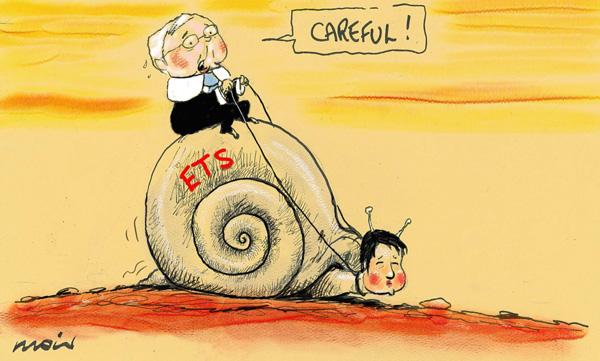
So we have the resolute defence of the trade-exposed industry and coal fired powered electricity generating industries---in the form of free permits instead of an auction, extensive compensation, heaps of spin about all the wonderful things being done to facilitate the emergence of a renewable energy industry and hypocrisy about saving the River Murray and the Great Barrier Reef. Energy policy is pretty much limited to the black and brown stuff that is dug out of the ground.
Yet Rudd's scheme is minimal: a low reduction target of 5 per cent, starts on July1, 2011, there will be a one-year fixed price for carbon until July1, 2012 at an extremely low $10 a tonne, the impact on households and businesses will be minimal, and even more compromise can be expected for the multinational companies that own the heavily polluting coal fired electricity generators in the La Trobe Valley. The CPRS is weak on polluters.
The whole point of an emissions trading scheme is to force polluters to pay for the harm they do to the planet. The rhetoric from the polluters is that an emissions trading scheme is a “sovereign risk”, which the energy corporations say can only be mitigated by the government giving away free emissions permits to companies that might otherwise have to pay to continue to pollute.
What they are saying is that businesses have a right to compensation from changes in government legislation and regulation. Sovereign risk is the risk of the state using its power to alter the established rights of private sector companies. It is a risk to private sector participants that a project's implementation may be hindered or prevented, or its operation adversely affected in that a cap and trade scheme imposes poses a significant economic constraint on the established business activities of business.
Both state and commonwealth governments melt like butter in a heated up world at the very mention of sovereign risk and they grant all sorts of perks to sectional interests even though they know that issuing free permits would reduce the long term incentive to reduce greenhouse emissions.
The basis of the opposition to free allocation is the lower efficiency and less transparency that accompanies free allocations in that an indiscriminate spraying of compensation towards interests that press strongly for it would greatly increase the ultimate costs of mitigation.
What has not happened is that the claim of sovereign risk arising from the implementation of an emission cap on electricity producers in Australia has been tested. Shouldn't the electricity producers have anticipated the introduction of significant emission constraints? Shouldn't investors in electricity generators reasonably be expected to have included this already in their valuation of high emission power stations, including those purchased in privatisations a decade ago?
Posted by Gary Sauer-Thompson at 7:33 AM | Comments (1) | TrackBack
August 11, 2009
IPA on the national broadband network
Chris Berg in PM's national broadband plan really is no net gain in the Sydney Morning Herald starts off on a promising note. The editor of the IPA's Review asks: "Has there ever been a major Commonwealth program more hastily conceived than the national broadband network?" (NBN)
It's a good question, and one that needs to be asked since the price tag of $42 billion is questionable and there is little prospect that NBN Co can be financially sustainable on a standalone basis. The commercial viability of the NBN is addressed in the Goldman Sachs JBWere's report.
This argues that it will take until financial year 2017 before 50 per cent of homes are passed by the network, and until 2028 before 85 per cent of homes are connected. On their forecasts NBN Co won’t be free cash flow positive until 2025. So the original concept of a giant public/private partnership will founder without massive and ongoing government subsidies.
Berg's answer to his question is that the NBN was most hastily conceived but he slips way from public policy:
After it was clear their previous $4.7 billion broadband plan was a dismal failure, it was reported Kevin Rudd and the Communications Minister, Stephen Conroy, dreamt up this $43 billion plan while on two flights between Sydney and Canberra in April.That's not just policy on the run. That's policy desperately sprinting from a horde of angry zombies while trying to pretend that the bite mark on its arm is nothing to worry about.
There was a review process with recommendations as opposed to a "horde of angry zombies". That's abuse ---name calling those who argue in favour of a highspeed national broadband network and a digital economy.
For Berg a digital economy is utopian, and government subsidies for it are akin to government subsidies for sunshine, flowers and walks on the beach. 'Utopian' is a code word for Left here since it refers to equity of access, not the neo-liberal utopia of a self-regulating market efficiently allocating scarce resources. However, Berg does comes back to policy:
The most common argument for government-sponsored broadband is productivity. But the national broadband network isn't going to be a magical productivity switch. There just aren't many potential Australian entrepreneurs having their innovative business plans stymied because their broadband isn't fast enough. Some businesses might find a faster internet connection useful, but few people seriously think our present internet speeds are what's holding the economy back.
It's more than just needing to be fast for businesses--there is also spread and access, given the problems in regional Australia. So what's holding the economy back, then? Berg is pretty clear from this paragraph:
Anyway, our hunger for ever-greater productivity might be better satisfied by allowing the private sector to build the network. (As much as four years ago Telstra was begging the government for a regulatory reprieve so it could build a new broadband network by itself.)
Wow. A company notable for its anti-competition stance, its anti-regulation, poor service, high cost products and slow backhaul is the answer. A company found to have rejected requests for third parties to install equipment in telephone exchanges across the country where space was found to have been available.
We can infer that the issue for Berg and the IPA in general is one of government intervention and subsidy. The government should not be building the network nor providing the massive subsidies needed to get it up and running.This is what is holding the economy back, and the reason why it is not good public policy.
The second reason Berg offers is that, "if it's productivity we want, perhaps the Federal Government could just reduce a few taxes. That'd give the economy a bit of a kick-along." Didn't the Government bring in tax cuts during its first budget? The issue is one of tax cuts versus subsidies in the context of the national broadband costing consumers more for the service than they are paying now.
Issues of government intervention and subsidy for the NBN are core issues and do need to be debated, but the desire to debate is blocked by Berg's turn to abuse--"horde of angry zombies". The immediate reaction to this is why bother to engage?
Posted by Gary Sauer-Thompson at 10:53 AM | Comments (7) | TrackBack
August 10, 2009
playing politics
The Government's popular renewable energy scheme has been linked to its controversial emissions trading scheme (CPRS), which faces defeat in the Senate on Thursday. The two schemes were linked by the Rudd Government in May of this year in order to put pressure on the Liberal Opposition in the Senate to pass the emissions trading scheme. Though the CPRS scheme already provides massive support for the big polluters, the Coalition is calling for even more support to save jobs. Turnbull wants electricity generators to buy permits only for extra greenhouse gas emissions above a “best practice” baseline, rather than for all their emissions. So much for Labor's political pressure.
Now the Coalition does support the renewable energy scheme, which merges the state renewable energy schemes into a national scheme that will seek to produce 20% of our energy from renewable energy. Both the Greens and the Coalition support the passage of this legislation and want it passed as stand alone legislation. Senator Wong refuses and calls on Turnbull to pass the CPRS legislation. However, Turnbull shows little interest in doing that, as he hasn't even proposed any amendments to the legislation. So much for the wedge.
The inference? The Rudd Government is engaged in playing politics at the expense of policy reform, despite Australia’s large, but under-utilised renewable energy potential---- wind, geothermal, concentrated solar and biofuels as being crucial technologies. Or despite the biggest gap in Australia’s current policy setting being the absence of a strong, well coordinated and well financed strategy for research, development and deployment of renewable energy. This short-term political tactics at the expense of long-term strategy has the effect of procrastination.
The Rudd Government appears to be not that interested in actually making the shift to a low carbon economy, or in facilitating the emergence of green manufacturing and jobs. They appear to reckon that the clean energy powered industrial revolution is around the corner and over the horizon, and they give the appearance of being unconcerned that it is the absence of a long-term low-carbon policy framework or coherent set of policies that acts as a major impediment to the development and deployment of low-carbon technology.
This Breakthrough on Technology: Perspectives from Australia report from the Climate Change Institute says that there is a need for a mix of technologies (including carbon capture and storage (CCS) technologies) to be developed and deployed to meet Australia’s abatement challenge over the coming decade. There is also a need to ensure the rapid and ongoing improvements in energy efficiency across new buildings and appliances, as well as improved policies and incentives to make efficiency gains in existing commercial buildings and industrial facilities.
Australia has the potential to contribute to the development of new technologies, because of its highly skilled work-force, established research base and comparative advantage in certain technologies. But Rudd’s economic stimulus infrastructure package, which would have been a great opportunity to encourage a move to renewables, through direct grants and improved infrastructure, went to upgrading roads, rail and ports to facilitate the export of coal to fuel the power stations of Indian and China.
Update
Rudd & Co have no intention of reducing the power companies’ reliance of coal and oil as quickly as possible. They would probably even spin any investment in new coal fired power stations as job creation in regional Australia. If the fundamental reason for bringing in an emissions trading scheme is to make polluters pay for the pollution they cause, and to send a signal to investors and the community to move in a new direction, then the CPRS sends a signal to polluters that they can continue to pollute regardless. The Green's name for Rudd + Wong's CPRS -- the Continue Polluting Regardless Scheme--is apt. What they do have right is the economics in that it is better to get price of carbon right and then to soften the income issues with compensation.
Update2
The Rudd Government's CPRS (cape and trade scheme) is shaping up to be a dud because it gives too much leeway to dirty industries. Rather than auctioning the carbon allowances, the bill that recently passed the House of Representatives would give most of them away to powerful special interests. Companies do not have to bid on the right to emit carbon into the atmosphere. This was the mistake the Europeans made in setting up a cap-and-trade system,
The economic modelling of Frontier Economics scheme taken up by the Liberals is based on electricity generators, including coal-fired electricity, being given free permits based on a ''baseline''.
In the reworking of their submission to the Commonwealth Department of Climate Change on the emissions trading scheme Green Paper, electricity generators would receive a certain amount of free credits based on a government-determined ''industry standard'' of carbon emissions. If generators exceed that level they have to buy more permits, if they fall below they can keep the permits and sell them into the carbon market for a profit.The permits are international one.
So two issues are raised. The amount and form of compensation to electricity generators and the level of international trade in permits.
Posted by Gary Sauer-Thompson at 9:28 AM | Comments (11) | TrackBack
August 9, 2009
Fairfax joins News Ltd: goodbye free
So Fairfax, along with News Ltd is also moving to charge for access to their websites including the Sydney Morning Herald and The Age. The free content gravy trend must end. Consumers are going to have to learn to pay for content online as they do in print or via cable, for music and movies. The aim is to get the Googles and Huffington Posts of the online world to pay "fair compensation" for content they pick up and then sell advertising on. Yet the Google portal are creating win-win situations for publishers, whether it’s sending them traffic or providing feedback on headlines that draw in readers.
As the Wall Street Journal editorial points out, the larger story here is the familiar process of economic "creative destruction," in this case brought on by the Internet. Advertisers are fleeing to search engines, while barriers to entry in publishing have crashed. The legacy media have been struggling with the online model for years now and they have limited success to show for their studies, experiments and worries. When The New York Times abandoned its subscriber Times Select pay tier, it made the decision that it could make more from advertising to large numbers than from a combination of subscriber revenue and lower advertising dollars.
Not to be deterred Fairfax are proposing/considering two levels of access, one free and the other incurring a charge. Fairfax chief executive Brian McCarthy said that charging for online access was essential if publishers were to maintain their newsroom staff:
Monetisation will have to happen, because without monetisation of the online sites that the newspaper industries have operated very successfully, we can't afford to keep the big newsroom staffs we have. ...We have a monetisation challenge. 'We're certainly getting the [online] traffic. We're getting the advertising, but it's not a user-paid model in terms of the reader.
Though the number of people reading newspaper online sites is reported to have doubled in the past two years, the problem for the legacy newspaper industry is that while it has been giving away its core product, online advertising has not compensated for revenue decline from newspaper advertising. Nor will it.
The newspaper industry is in trouble, no one questions that. The corporate media's shift to charging customers will not compensate for revenue decline from newspaper advertising. Nor will the mixed revenue models prevent the continual layoffs of staff as the legacy media trim costs and bring them more in line with reduced revenues. Moreover the legacy media do not have a fast-paced culture of innovation.
So what are we consumers going to be charged for? The quality of the Fairfax papers is declining, and it has been for some time. Will Fairfax's plan to rebuld the media by introducing a new national online news, commentary and analysis site, (nationaltimes.com.au to be launched next month, initially free) address this decline? Will it be something akin to, and in competition with, The Punch? Moreover, Slate magazine tried a paid wall and dumped it after a year.
I would not pay to access Punch, and I cannot see why I would bother to pay to read the SMH or The Age online. I would get my news from the ABC and I would not pay to read yet opinion piece from the Canberra Press Gallery----(eg., from a Michelle Grattan or a Peter Hartcher) on the woes of the Liberals. What is the premium end of legacy media? . The news media has lost touch with people's needs and interests during the past 30 years, as demonstrated by rapidly declining readerships of newspapers and audiences of broadcast news.
The Canberra Press Gallery is heavily dependent on official sources and this gives the news an inherently conservative cast and gives those in power tremendous influence over defining what is or isn't 'news'. What isn't offered is a ruthless accounting of the powers that be.' The Canberra Press Gallery does little to counter the publicity and flak from the corporations pushing their interests in the public sphere, as more often than not, it functions as part of this media machine to airbrush from reality diverse and dissenting views. The Canberra Press Gallery is noted more for its servility to power rather than speaking truth to power.
Where then do those in open source world go during this transitional period in the context of deliberative democracy? What will probably develop is an array of Web sites that focus on local news commentary. Their initial form will be compendia of links to local government sites, some blogs and even local news from other sources. Should they gain traction some will start adding original content from citizen journalists. The digital technologies here, and still emerging, make it far more efficient to provide news, entertainment, whatever, to each of us in more forms than at any time in history.
The bloggers as commentators on the events of the day need to lift their game as the forces of technologies, consumer behavior and the marketplace play themselves out. If commentary on a piece of journalism is fair use, then how they left their game? What needs to be done for us to innovate and lift our game?
Posted by Gary Sauer-Thompson at 8:30 AM | Comments (15) | TrackBack
August 8, 2009
goodday sunshine
Big banks show big profits, the stock market is up, bonuses are back, even manufacturing output is rising … so the recession is over already.The inference is that markets work well, the business cycle is self-stabilising and it is business as usual. Though it looks to be a jobless recovery, central banks are talking about raising interest rates to prevent inflation.
 Martin Rowson
However, a stock market rally is not enough to ensure that households and firms purchase the goods that will maintain employment. The employment figures do not account for the increasing numbers of people working part-time who'd rather have full-time job; nor a large number who have given up looking for work.or those who have found new jobs that pay less than the old ones they lost.
Nor do they indicate that most of the jobs that have been lost are never coming back.
Though new jobs will replace some of them, eventually, but --not all of them- we need to recognize that the structure of the Australian economy is changing.
What's pushing the stock market upward? Isn't it corporate profits? However, those profits aren't being powered by consumers who have suddenly found themselves with a lot more money in their pockets from increased work. The profits are coming from dramatic cost-cutting -- if a firm cuts its costs enough, it can show a profit even if its sales are still flatlined.
Posted by Gary Sauer-Thompson at 10:34 AM | Comments (1) | TrackBack
August 7, 2009
SA: squeaky clean?
SA, along with Victoria, has refused to regulate political donations and lobbyists, and establish an independent anti-corruption body. The resistance by the Rann Government to the political pressure is one of teh government digging its heels in. It maintains that there is no political transparency issue in SA. There is no corruption in public administration, and there is nothing wrong with how the ALP gets its millions of dollars to fight its election campaigns.
Rann's response to any questioning has always been the same: we are different in South Australia, there is no problem, and so need to establish an independent commission against corruption. The inference is that access to government is not being bought, Labor mates are not being appointed to high-paying positions and retired politicians are not exploiting their political connections for "success fees".
The political class in SA have erected a wall around their activities and networks, and they are defending it by deflecting all calls for accountability by citizens calling for greater democracy. It shrouds some of its activities in secrecy by ‘‘sham claims’’ that voluminous documents were ‘‘cabinet-in-confidence’’ and therefore exempt from public release.
In a speech to mark 20 years since his landmark report on corruption in Queensland, Fitzgerald had a message for political leaders generally, not just in the Sunshine State.
Despite their protestations of high standards of probity, which personally might well be correct, and irrespective of what they intend, political leaders who gloss over corruption risk being perceived by their colleagues and the electorate as regarding it of little importance. ‘Even if incorrect, that is a disastrous perception.‘Greed, power and opportunity in combination provide an almost irresistible temptation for many which can only be countered by the near-certainty of exposure and severe punishment.
Fitzgerald cautioned that politics was about more than gaining and retaining power. In SA the reponse to Fitzgerald was a shrug of the shoulders.
The appearance in SA is one of corporatism--- a nexus of unions, big business and companies running the show with the media appearing to become captive to power and money. The consensus of this ruling bloc (neo-corporatism?) is dedicated to enforcing political and social stability at the expense of democracy.
The danger here is that the political system becomes overloaded with corporate interest located inside rather than outside the bureaucracy that an embedded and entrenched system of entitlements and special privileges for the powerful groups involved becomes the norm. Though there is an absence of a political tradition that has corporatism as a framework for analysis, the popular name for this tendency is crony capitalism.
The neo-liberal attempts to dismantle it have been successfully deflected and the interest group liberalism and pluralism remains the main representation of the political system. This fails models to grasp how big industry has moved inside the bureaucracy and operates within the system. The Greenhouse Mafia is a classic example.
Posted by Gary Sauer-Thompson at 6:45 AM | Comments (5) | TrackBack
August 6, 2009
Malcolm in the middle
What are the chances of Malcolm Turnbull surviving as the leader of the Liberal Party and winning the next election? It's zilch on the latter. It is extremely unlikely that Malcolm will ever became PM. His ambition will be thwarted as the Liberals look to be going backwards after the attempt to king hit Rudd and Swan in the Ozgate episode backfired so spectacularly:

They need to do everything in their power to reduce the electoral damage. The Australian will continue to campaign for Turnbull to be dumped, whilst the Nationals will continue to distance themselves from the Liberals as they realize that they need to develop a more independent political profile to survive.
Will the Liberals rethink their faith in self-correcting neoclassical economic model--question the elegant self-correcting free-market equilibrium theory?
Or will they continue to cover up the anomalies with the theory with the claim, along with the IPA that the current economic crisis is due to regulatory, and not market, failure and that we are witnessing the financial market self-correct in the most dramatic of fashions. Those who think otherwise express an anti-market bias The anti-market bias is the tendency to under-estimate the benefits of the market mechanism. The corollary is that the benefit of government intervention is over-estimated.What we can infer from this is that most macroeconomists are still blinded by the idea that efficient markets will take care of themselves.
Will the Liberals continue to defend big central government in opposition to the small government ethos in classical economic liberalism and neo-classical economic theory. Just how committed to liberalism are the Liberals?
Posted by Gary Sauer-Thompson at 6:57 AM | Comments (9) | TrackBack
August 5, 2009
closing the gap?
Alison Anderson, the Indigenous Policy Minister, has used her resignation from the Henderson Territory Government over its failure to defend her from Nigel Adam's attack on indigenous politicians in the Northern Territory News to draw attention to inadequate housing for indigenous people. She highlighted the way that millions upon millions of dollars flowing into the Territory from the federal government, supposedly to combat indigenous disadvantage, end up in the hands of the Northern Territory bureaucrats and channeled to the politically crucial northern suburbs of Darwin. This is the politics of white (collar) populism.
Her finger was pointed at the NT Labor government of Paul Henderson, and the administration of 'closing the gap' in Indigenous disadvantage. Two years after the announcement of a massive injection of federal funding to address overcrowding in Indigenous communities not a single house has been built.
Now that ex-Deputy Chief Minister Marion Scymgour is back inside the Labor tent, Henderson will have to rely on Anderson or the other NT Independent Gerry Woods to pass any legislation or win motions in the Assembly - and he will still require the casting vote of the Speaker of the Legislative Assembly, Jane Aagard. Shaky ground for a government under siege.
There is a disconnect between Aboriginal people living in remote townships and NT Labor given its quarry vision for the NT, and its embrace of assimilationist tendencies in its Working Futures policy that 10,000 people be moved away from their homelands to create new ghettos in an arbitrary selection of so-called ‘growth towns’. Marion Scrymgour, one of four black Labor MLAs, had resigned from the party in protest at the government's outstations policy, a program which critics say is aimed at driving Aboriginal people off their country and into larger urban centres.
Anderson went public over her concerns about the Henderson Government's handling of the Strategic Indigenous Housing and Infrastructure Program (SIHIP), following a briefing in which she was told that only 30 per cent of the $672 million would actually be spent on new homes. That means up to 70 percent of SIHIP funds would be spent on administration. She was also told that SIHIP - which is yet to deliver a single new house - could result in the building of fewer than half the 750 homes promised at its launch 15 months ago.
Black Australia is finally flexing some political muscle in the Northern Territory.
Posted by Gary Sauer-Thompson at 12:23 PM | Comments (25) | TrackBack
homegrown terrorism
Australia now has its own home-grown terrorism. Australian police have detained four men suspected of planning to assault an army barracks in Sydney and charged three. The suspects from the Somali and Lebanese Australian diaspora are said to have links to Al-Shabab in Somalia, which is understood to have affiliations with al-Qaeda. Thankfully, we have a counter extremism strategy that does not involve the ramping up of the terrorism alert to red, the deployment of the politics of fear, and the strident rhetoric about the war on terrorism and al-Qaeda associated with the Howard conservative regime that made political Islam the Other that had to be destroyed.
In Australia Somalia is represented as a failed state and a dark and dangerous pirate theme park where American ship captains and US special forces go to gain their 15 minutes of fame.This is a world of pirates, Islamists, refugees, anarchy, civil war. This is the world of al-Qaeda not modernity.
The ABC report I saw talked about Islamic extremists trying to overthrow the government of Somali without mentioning that the previous Somali Transitional Government was allied with Ethiopian forces backed by the US; that Ethiopia's occupation was an unprecedented disaster; that the U.S.-Ethiopian intervention s fanned the very extremist flames it intended to extinguish; and that the current Government in Somalia is a moderate Islamist one with Sharia law; President Sheikh Sharif is a former chairman of the Union of Islamic Courts (UIC).
The UN backed national unity or transitional federal government that emerged from the Djibouti peace process faces a hostile opposition from radical and insurgent Islamists, which include Al-Shabaab. This has developed into fighting between the transitional government and the hard-line Islamist factions in Mogadishu. The two (loosely allied) Islamic groupings--- al-Shabab and Hizb-ul-Islam---are in effect splinter groups of the former Islamic Courts Union and they are strongly opposition to the new transitional government.
So the lengthy civil war continues. Somalia is still in crisis. Another Afghanistan, in that the countless foreign interventions have made Somalia a terrorist hotbed?
The International Crisis Group argues that these oppositional Islamist groups/militias need to be drawn into, and become part of the political process to build a functioning federal state:
The biggest obstacle to peace in Somalia this time may in fact not be Somalis' infamously fractious politics but the reluctance of the international community to engage with the Islamist opposition. However, if there is going to be a lasting settlement that returns even a semblance of stability to the country, Islamists cannot be excluded.vIf they are kept out of the process, the extremist Islamists will maintain the upper hand and, quite simply, there will be no process. In that case, peace would, yet again, remain a distant illusion for Somalia's suffering population.
If people who have a political grievance are not at the discussion table, they will find some other way to get noticed or to derail the political process. Hence the pattern of Islamic radicalisation in Somalia opposed to the current government that represents a confluence of western-backed secular governance and moderate former members of the Islamist-led insurgency.
There is little doubt that a growing threat to Australia's national security from within stems from Australia's involvement in Iraq and Afghanistan. Australian nationals of Muslim background, who are frustrated with the perceived injustices committed against Muslims in the two countries, have joined extremist Islamic groups in protest against Australian foreign policy.
Australian citizens of Somali origin are being recruited and radicalized by al-Shabab, which appears to be increasing its recruitment in diaspora communities in North America, Europe and Australia in an effort to become a trans-national network on an al-Qaeda model.
Posted by Gary Sauer-Thompson at 9:32 AM | Comments (15) | TrackBack
August 4, 2009
Canberra gaze
Turnbull and the Liberals are going to have some trouble putting the OzCar affair behind them and moving on to greener fields of economics and deteriorating budget fundamentals. Hope springs eternal I guess, even though the storm clouds are massing.
Ozgate is still now, and it is lead in the saddle. A very sick Godwin Grech, the Treasury official who testified before a Senate committee that he recalled an email from the PM’s office about John Grant, has admitted writing the fake email. Australian Story, which was filming in Turnbull’s office when the story broke that the fake email had been found at Grech’s house, showed the shock and bewilderment within the office. They had thought the email was real.

Unfortunately for Turnbull Grech said he handed a printout of the email's contents to Mr Turnbull and Senate deputy leader Eric Abetz -- which he later took back -- at a meeting at his wife Lucy Turnbull's office in Sydney's Potts Point on June 12, one week before Grech's evidence before a Senate inquiry. Turnbull must have thought that he'd struck gold-- the means to land a killer blow on Rudd.
Even worse for Turnbull, Grech wrote down a series of questions for the Opposition Leader to ask in parliament concerning Rudd's statements that he had not sought special favours for John Grant, the Ipswich car dealer.
Grech also says he never authorised anyone to publish, report, comment or discuss the contents of the email, which he showed Turnbull and which he discussed in a telephone conversation with a journalist that Turnbull arranged. The Liberals sacrificed him.
Turnbull has been damaged by Ozgate and more fallout can be expected in the future from the up-close-and-personal nature of his involvement with Grech. The favourable presentation of Malcolm in the soft sell of Australian Story has already been swept away by Grech saying that Turnbull was deeply and personally involved in the release of what he believed to be an email that could bring down the Prime Minister.
A betrayed Grech is going to be sacrificed by the Liberals in full damage control mode. Turnbull's defence had been built around Grech's public testimony at the Senate hearing, not previewing the email. They will throw as much doubt as they can on Grech's central defence that he gave them information in the hope that it would assist the passage of the emergency car financing bill.
Update
The Auditor General's Ozgate report clears Rudd and Swan, and points the finger at Godwin Grech. However, it is also heavily critical of Treasury for allowing Grech to be under huge pressure to deliver the dealer finance program by himself. The delays in establishing the program because of a lack of resources helped to create the situation in which Grech was asked to find private finance for dealers and this opened the situation to political referrals from MPs.
Grech writes in his response that Treasury did not reduce his workload adequately - despite the fact that he was hospitalised repeatedly to deal with a small bowel obstruction, kidney disease, osteoporosis and a metabolic bone disease. Other parts of his response indicates that he judges Turnbull used him to attack Labor's crony capitalism until he became toxic, and has now discarded him like a used rag. Betrayal.
Posted by Gary Sauer-Thompson at 8:22 AM | Comments (31) | TrackBack
August 3, 2009
media futures: going local?
The Media, Entertainment & Arts Alliances' important Future of Journalism initiative is concerned with what journalism might become with the decline of the old print business model and people increasingly consuming their comment, analysis, fun, trivia, whatever on the internet. Their Life in the Clickstream: The Future of Journalism was mentioned in this post and analysed in the comments of that post.
Their Wired Scribe weblog run by Jonathan Este is essential reading for anyone interested in knowing what people are saying about the paradigm shift in the media now happening around us. This post gives us new material by Jay Rosen, Phil Meyer and Roy Greenslade from the Sydney discussion, which was concerned with the scale of the pace of change. I do not know the focus of the subsequent Melbourne and Brisbane meetings/discussions.
One is planned for Adelaide late this month and it sounds as if it will consider the opportunities for new forms of journalism--looking to be more proactive about the revolutionary changes caused by the digital technology of the internet. That probably means journalists needing to acquire new skills an a different understanding of journalism.
Greenslade, from The Guardian made an interesting observation at the Sydney forum about the digital revolution:
I think also we are going to see two apparently contradictory things at the same time, one is globalisation and the other is localism. That is, that I think we will see the creation of local journalism, relatively small, much more involving of citizens, reporting on their community. But we are also going to see globalisation in the sense that we’re going to see at the moment: powerful brands, if I can use that awful word, like The Guardian, like The New York Times, like the Financial Times, where you’re seeing larger audiences outside their home base for those publications than you do at the moment. So, for instance we have more readers of The Guardian in the United States than we do in Britain on the Web. So, I think that powerful brands across the world could very well be the new emergence of journalism.
The truth of the matter is that as no Australian newspaper is likely to become a global newspaper they are going to have to reduce their costs and profit margins to bring them in line with reduced revenues. So they become lean and mean through layoffs and rationalizing their operations.
Though there’s lots of people already building the digital world what isn't really happening here in Australia is the emergence of local digital journalism, broadly defined that has its roots in the community. In Adelaide, for instance, we have future digital possibilities in the form of The Independent Weekly and The Adelaide Review, but these still look back to their print past. Presumably, their publishers have not invested in a digital future because they do not see it as a profitable business model. Since they are doing very little by way of creating value on the internet, there needs to be other ways to develop new forms of practising journalism, or facilitating a regional conversation on the internet about what is happening in SA.
Much more future promising is the embrace of a new collaborative form of journalism by the ABC, with its idea of digital regional hubs. But this form of citizen journalism and user-generated content is still on the drawing board. This open source model, in which there are lots of writers, lots of people who know stuff and lots of people who are in a position to issue an accurate report or to give a view on an issue will run into problems of finding people who will end up becoming regular or reliable contributors.
The Gatewatching crowd argue that:
online news sites operated by trusted public media organisations such as the ABC and SBS, and under the governance of clear and progressive guidelines for public media and their role in modern society, currently provide the best opportunity for citizen involvement in news, opinion, and public affairs.
The ABC is in the process of becoming a public media organisation.
Posted by Gary Sauer-Thompson at 7:46 PM | Comments (6) | TrackBack
SA: The defence state
I was down at Port Adelaide yesterday checking out photographic possibilities around Techport Australia and the Mutton Cove Conservation Reserve on the Lefevre Peninsula.
Most of the Peninsula is now a prohibited area. SA is becoming the defence state. Techport Australia is the naval industry hub that is being developed at Osborne, South Australia. This defence precinct appears to be a "campus concept", combining shipbuilding, engineering, high-tech systems and a commercial and an education precinct. This is thinking long term.
What do we need this massive new investment in naval defence (Collins-class submarines, air warfare destroyers etc) for I wondered. Who are we defending ourselves from? What are the threats? Is it about the "war on terror". The increased emphasis on military spending (lots of big boats) implies military threats. From Indonesia? China? Or is there something else going on in this long term military security thinking?
Paul Rogers in A new security paradigm: the military-climate link at Open Democracy makes an interesting point in terms of the relationship between national security and climate change. Climate change for the defence analysts and think tanks is a security issue and they think in terms of conflict control. Rogers says:
No one doubts that some degree of climate change is going to happen, indeed is already happening. It will not be reversed and there will be serious human impacts. But the central problem with the great majority of military scenarios is that they are predicated on a narrow view of the security of the state. Military-analysis research institutes may well have great expertise on vital contemporary global issues - for example, climate change, socio-economic divisions and energy security. But they see their role as one of protecting the state or alliance of which they form part. If climate change is going to be hugely destabilising, then (goes the argument) we must have the forces necessary to protect ourselves from the consequences.
Rogers adds that it is for this reason that the Australian navy is investing in a fleet of long-range patrol-craft to secure the waters between its northern territories and southeast Asia. Climate change acts as a threat multiplier for instability in this volatile region of the world causing widespread political instability and the likelihood of failed states. So conflict-control means new weapons and technologies rather than making a shift to a low carbon economy.
How this account requires the navy to bei much more geared up for conventional war is beyond me. It implies a kind of thinking that views the world as a jungle and that jungle has to be tamed.
Posted by Gary Sauer-Thompson at 1:27 PM | Comments (4) | TrackBack
August 2, 2009
beyond newspapers v bloggers
Michael Massing in The News About the Internet in the New York Review of Books takes up the issue of the relationship between declining newspapers and emerging internet bloggers. The conventional perspective from the world of the newspapers is a put-down of the Web and the bloggers in that the latter are held to contribute little more than repetition, commentary and froth.
Massing points out that:
This image of the Internet as parasite has some foundation. Without the vital news-gathering performed by established institutions, many Web sites would sputter and die. In their sweep and scorn, however, such statements seem as outdated as they are defensive. Over the past few months alone, a remarkable amount of original, exciting, and creative (if also chaotic and maddening) material has appeared on the Internet. The practice of journalism, far from being leeched by the Web, is being reinvented there, with a variety of fascinating experiments in the gathering, presentation, and delivery of news. And unless the editors and executives at our top papers begin to take note, they will hasten their own demise.
Blogging has gone beyond the snip-it-and-comment approach that riffs on the journalism of others while doing no conventional reporting of their own in the sense of gathering, presentation, and delivery of news. The commentary has broadened into a concern with subjects that newspapers are no longer interested in.
Massing is primarily concerned with news and investigative journalism than commentary. So we have the usual US blogosphere mentions, such as Talking Points Memo, ProPublica, FireDogLake, Informed Comment, Mondoweiss, Brad DeLong and Glenn Greenwald to make his case that new ground is being broken by those working in the blogosphere. With respect to the financial crisis he says:
For the most part, though, the coverage of the financial crisis in the daily press has been episodic, diluted, cloaked in qualifiers, and neutered by comments and disclaimers from businessmen and their paid spokesmen, to whom mainstream journalists feel obligated to give equal time.The bloggers I have been reading reject such reflexive attempts at "balance," and it's their willingness to dispense with such conventions that makes the blogosphere a lively and bracing place.
He argues that such initiatives suggest a fundamental change taking place in the world of news. Power is shifting to the individual journalist and away, by degrees, from journalistic institutions; that the emergence of the Internet is loosening the grip of the corporate-owned mass media and that a profound if unsettling process of decentralization and democratization is taking place.
Posted by Gary Sauer-Thompson at 1:47 PM | Comments (16) | TrackBack
August 1, 2009
regulating financial markets?
It is not just the non-traditional banking sector or shadow banking system (hedge funds) that needs regulating. It is also the credit agencies such as Standard and Poor and Moody and Fitch, which are paid by the companies whose securities they are evaluating in lieu of the checks and balances on financial risk.
What we have had so far is spending increases, tax cuts, bank recapitalisation, purchases of risky assets and money-supply expansions:
 Moreland
If few modern governments are now willing to let financial market's work their way out of a panic/crisis by themselves, then there is little by way of regulation to ensure the stability of the financial system as a whole. Where is the equivalent of antitrust legislation to reduce the sort of market power and political influence the big banks now have?
What we have is a rescuing of the financial system without reforming it--what Paul Krugman calls the government’s provision of a financial backstop — an assurance that it will rescue major financial players whenever things go wrong.